
By Laura Tolentino
Texas A&M’s 19th annual disaster response simulation
will prioritize student learning in swapping event locations and refocusing
student leadership roles
After spending nearly a decade at Texas A&M
Engineering Extension Service‘s (TEEX) Disaster City®, the collaborative
event is moving to the Brazos County Expo and overhauling its planning
structure, said Christine Kaunas, EdD, MPH, assistant
vice president for Interprofessional Practice, Education and Research, the Texas A&M
Health office that oversees Disaster Day coordination.
“Disaster City has been an amazing location to set the
scene for our student participants, and TEEX will continue to be essential
event partners for Disaster Day moving forward,” Kaunas said. “Adjusting
locations just changes the logistics of event planning and execution in a way
that lets our students spend even more time focusing on collaboration, patient
care and disaster response.”
The new venue features multi-room, adaptable
accommodations, including a large arena, in addition to on-site parking,
eliminating the need to bus in student participants and volunteers from a
secondary location. The space will lend easier access and greater flexibility
to execute the disaster simulation for the hundreds of participants who attend
Disaster Day.
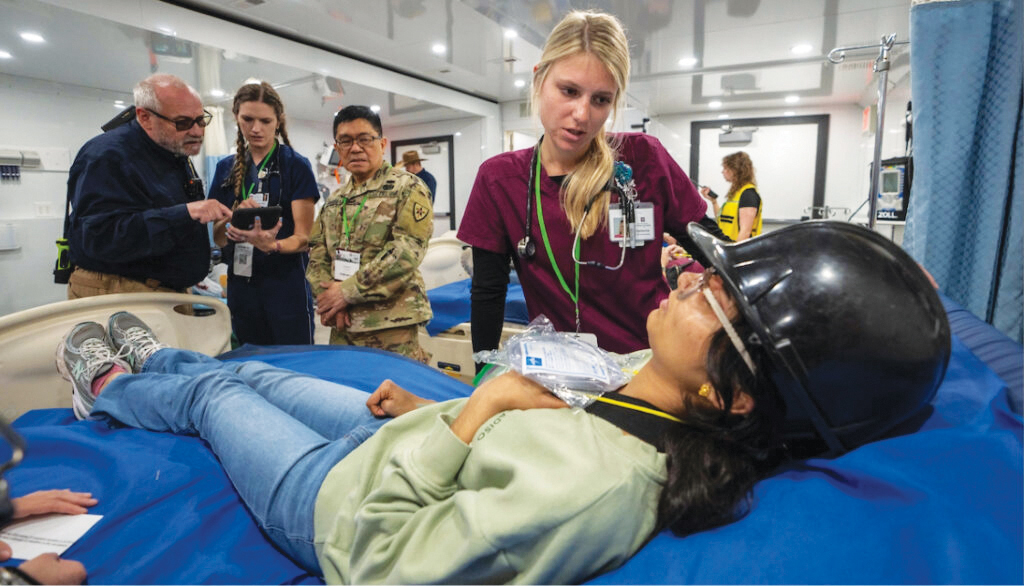
“We’ll still have our hospital tents, medical equipment and
realistic moulage,” Kaunas said. “Our goal is always to provide students with
an experience that closely mimics the sights, sounds, feel and available
resources of a real-world disaster response environment. That hasn’t changed.”
Over the years, Disaster Day has found an expert partner in
TEEX. As sponsor of Texas’ elite urban search and rescue teams, Texas A&M
Task Force 1, Texas Task Force 2 and Texas A&M Task Force 3, TEEX serves as
a “comprehensive training provider through more than 80 years
of extension training.”
And TEEX is poised to continue providing expert insight for
Disaster Day, said TEEX Preparedness Program Instructor Tyler Watson ’27.
Watson participated in Disaster Day for four years, starting as a volunteer in
the fall of 2022 and eventually serving as the student planning director in
2025 before moving to his current role at TEEX.
“The real strength of Disaster Day is its collaborative
elements,” Watson said. “It brings together students and professionals from
across the university and the state in a unified effort to create an
unparalleled student experience. For the last five years, I’ve been privileged
to see it from all sides. The critical insight into real-life disaster
scenarios and training that TEEX provides will have an even more amplified
impact when paired with the resources available at Brazos County Expo.”
Disaster Day began in
2008 with a group of 35 students from the Texas A&M College of
Nursing. After noticing the disaster relief Texas A&M provided
for more than 650 individuals displaced by Hurricane Rita, the students
recognized a need for hands-on disaster relief training for tomorrow’s medical
professionals and first responders.
The simulation expanded over time to include a planning
committee of more than 50 students who met for six to eight months under the
guidance of Texas A&M faculty and staff to plan the annual, one-day event.
Event planners and simulation participants have ranged from 800 to nearly
1,000, depending on the year. They hail from across Texas A&M University,
including all five Texas A&M Health colleges and schools as well as
the Texas A&M College of Education & Human Development, the Texas A&M College of
Veterinary Medicine and Biomedical Sciences, and the Texas A&M Bush
School of Government & Public Service. Event partners include
multiple state and local government entities and non-governmental organizations
(NGOs).
In another update to previous Disaster Day events, the 19th annual simulation, taking place April 2,
2027, will not utilize a student planning committee, leaning instead on student
leadership within the simulation. Shifting all event planning logistics to
Texas A&M Health and TEEX professional staff and faculty frees up bandwidth
for students to further occupy leadership roles during the simulation, Kaunas
emphasized.
“Our priority is and always has been student learning,”
Kaunas said. “When we looked at the many pieces and people Disaster Day brings
together and really assessed our strengths, moving to the Expo Center felt like
a natural next step. Just like in years past, we’re still assembling the very
best experts and resources from across the Texas A&M System in the name of
student learning. This reconfiguration allows that effort to propel the student
experience that much further.”